9 Best Electric Pressure Washers (October 2026)
The best electric pressure washers include the Westinghouse ePX3500 for compact storage, the Westinghouse WPX3000e for distant outlets, and the Greenworks 3000 PSI Brushless for higher stated flow.
On this page (7 sections)
- How we chose the best electric pressure washers
- Electric pressure washer specs at a glance
- Best electric pressure washer picks for different jobs
- How do you choose the best electric pressure washer for your home?
- How do you set up and care for an electric pressure washer?
- What mistakes should you avoid with an electric pressure washer?
- Which electric pressure washer should you choose?
The best electric pressure washer for most homes is the Westinghouse ePX3500, a compact 19 lb model with steering wheels and a 25 ft hose. Choose a different pick if you need more cord reach, higher rated pressure, separate detergent tanks or a carry handle.
Electric washers suit regular household cleaning when you have a safe outdoor outlet and can work within the cord and hose reach. They avoid gasoline and engine upkeep, and many models store more easily than gas machines.
Start with our pressure washer buyer's guide for a wider view of machine types. If your main choice is between electric and gas, read electric vs gas pressure washers.
Our picks at a glance
-
1

-
2

-
3

How we chose the best electric pressure washers
We compared stated pressure and flow, hose and cord reach, nozzle options, detergent storage and portability. We gave more weight to features that make a washer fit a clear home use, such as a compact body, a long cord, or an easy way to carry the unit.
Brands don't all present pressure and flow the same way. Some products have both rated and maximum figures, while the Greenworks models describe flow alongside nozzle conditions, so use the stated context when comparing rather than ranking by the biggest number.
Electric pressure washer specs at a glance
The comparison table highlights the differences most likely to affect setup and daily use: pressure, flow, reach, storage and weight where available. Rated figures are more useful for comparing models when brands provide them, while a maximum claim is best treated as a peak figure.
| Product | Best for | Rated pressure and flow | Hose | Weight | Our score |
|---|---|---|---|---|---|
| Westinghouse ePX3500 | compact storage | 2000 PSI and 1.2 GPM | 25 ft | 19 lb | 9.1 |
| Westinghouse WPX3000e | distant outlets | 2600 PSI and 1.1 GPM | 8.9 | ||
| Greenworks 3000 PSI Brushless | higher stated flow | 8.8 | |||
| Westinghouse WPX3400e | brushless frame cleaning | 3000 PSI and 1.1 GPM | 8.5 | ||
| Sun Joe SPX3000 | switching detergents | 20 ft | 8.5 | ||
| Greenworks 2700 PSI Brushless | push-button starting | 8.4 | |||
| Kärcher K1700 | simple operation | 8.4 | |||
| Westinghouse ePX3100v | carrying by hand | 1800 PSI and 1.2 GPM | 25 ft | 17.6 lb | 8.3 |
| Craftsman CMEPW2100 | tidy garage storage | 7.8 |
Best electric pressure washer picks for different jobs
The ePX3500 is the most balanced pick for compact storage and wheeled movement. The larger frame models suit buyers who want cord reach and onboard storage, while the smaller or simpler options favor carrying, detergent flexibility or basic operation.
Westinghouse ePX3500: Best for compact storage
- 2000 rated PSI and 1.2 rated GPM
- 19 lb unit
- 25 ft hose
- Five nozzle options
A compact 19 lb design with four steering wheels, a 25 ft hose and five nozzle options. The rated output is 2000 PSI and 1.2 GPM.
Pros
- Compact 16.5 in height
- Four quick-lock steering wheels
- Onboard 20 oz soap tank
Cons
- Rated flow is 1.2 GPM
- Nozzle set includes a 0° tip that calls for careful use
The ePX3500 suits homeowners who need a washer that fits in a tighter storage spot. It stands 16.5 in high, weighs 19 lb and uses four quick-lock wheels designed to steer through turns.
Its rated output is 2000 PSI and 1.2 GPM. Westinghouse also gives maximum figures of 2500 PSI and 1.76 GPM at the lowest pressure, so compare the rated figures when judging its usual cleaning output.
Five nozzle options cover different spray patterns, including a soap applicator. The onboard soap tank holds 20 oz, and the pump stops when you release the trigger.
Choose it for a compact washer that rolls easily from storage to the work area. Skip it if you want a long power cord or a frame with large wheels.
Westinghouse WPX3000e: Best for distant outlets
- 2600 rated PSI and 1.1 rated GPM
- 35 ft GFCI cord
- 25 ft hose
- 0.45 gal soap tank
The WPX3000e pairs a steel frame and 10 in wheels with a 35 ft GFCI cord. Its 2600 rated PSI and 1.1 rated GPM suit buyers who want a full-size wheeled unit.
Pros
- Long 35 ft GFCI cord
- Steel frame and 10 in wheels
- Soap tank holds 0.45 gal
Cons
- Weighs 36.8 lb
- Rated flow is 1.1 GPM
The WPX3000e is a fit for homeowners whose outdoor outlet sits some distance from the cleaning area. Its 35 ft GFCI cord and 25 ft hose give you room to position the washer and move around a driveway or patio.
Rated output is 2600 PSI and 1.1 GPM. A steel frame, 10 in never-flat wheels and a 0.45 gal soap tank make this a more substantial setup than the compact ePX models.
The five nozzles include a turbo tip, a soap tip and three spray angles. The metal spray gun and wand use quick-connect nozzles, and the fittings are compatible with M22 pressure washer accessories.
Choose it for cord reach and a wheeled frame. Skip it if you'll need to carry the washer up stairs often; at 36.8 lb, it is better suited to rolling than frequent lifting.
Greenworks 3000 PSI Brushless: Best for higher stated flow
- 3000 PSI and 2.0 GPM stated
- TruBrushless motor
- 25 ft hose
- 35 ft GFCI cord
Greenworks states 3000 PSI and 2.0 GPM for this brushless model. It includes a 25 ft hose, a 35 ft GFCI cord and five nozzle options.
Pros
- 14 amp brushless motor
- Five nozzle options
- 25 ft hose and 35 ft cord
Cons
- Pressure and flow figures are maximum claims
- Unit weight is not stated in pounds
Greenworks states 3000 PSI and 2.0 GPM for this brushless washer. The brand says its pressure and flow claims were tested by an independent lab, and describes them as maximum output rather than rated figures.
It includes a metal gun, a 25 ft hose and a 35 ft GFCI cord. Five nozzle options cover narrow and wider spray patterns, along with soap and turbo tips.
Choose it if the stated 2.0 GPM flow and brushless motor match your priorities. Skip it if you want rated output figures for a direct comparison with models that publish both rated and maximum numbers.
Westinghouse WPX3400e: Best for brushless frame cleaning

- 3000 rated PSI and 1.1 rated GPM
- Brushless motor
- 25 ft hose
- 35 ft GFCI cord
The WPX3400e combines a brushless motor with a steel frame, 10 in wheels and a 35 ft GFCI cord. Its rated figures are 3000 PSI and 1.1 GPM.
Pros
- Brushless motor
- Long 35 ft GFCI cord
- Five nozzle options
Cons
- Weight is not stated
- Rated flow is 1.1 GPM
The WPX3400e pairs a brushless motor with a steel frame and 10 in wheels. Its rated pressure is 3000 PSI and rated flow is 1.1 GPM, while Westinghouse gives a maximum flow figure of 2.0 GPM at the lowest pressure.
A 35 ft GFCI cord and 25 ft hose provide reach from the outlet to the work area. The machine also has a 0.45 gal onboard soap tank, metal gun and wand, and five quick-connect nozzle options.
Choose it for a brushless frame model with high rated pressure. Skip it if your main priority is a high rated flow figure, since the rated flow is 1.1 GPM.
Sun Joe SPX3000: Best for switching detergents

- 2030 PSI working pressure and 1.2 GPM
- Two 0.9 L detergent tanks
- 20 ft hose
- Five spray tips
Two onboard detergent tanks let you keep separate cleaning solutions ready. The SPX3000 has 2030 PSI working pressure, 1.2 GPM flow and five spray tips.
Pros
- Two detergent tanks
- Five spray tips
- 20 ft high-pressure hose
Cons
- 20 ft hose is shorter than several picks
- Nozzle choice matters for delicate surfaces
The Sun Joe SPX3000 is the clearest choice for keeping two cleaning solutions on the washer. Its pair of 0.9 L tanks lets you store separate detergents for different surfaces or jobs.
It has 2030 PSI working pressure and 1.2 GPM flow. The package includes five quick-connect tips, a 34 in stainless steel lance and a 20 ft high-pressure hose.
Choose it when separate detergent tanks are more useful than extra hose reach. Skip it if your work area is far from the machine, since its hose is shorter than the 25 ft hoses on several other picks.
Greenworks 2700 PSI Brushless: Best for push-button starting

- 2700 max PSI
- Flow ranges from 1.2 to 2.3 GPM with included nozzles
- Brushless motor
- Push-button start
This Greenworks model has a push-button start and a stated flow range of 1.2 to 2.3 GPM with its included nozzles. It is a brushless option for buyers who value that start style.
Pros
- Push-button start
- Brushless motor
- 25 ft hose and 35 ft cord
Cons
- Maximum figures vary with nozzle use
- Unit weight is not stated in pounds
The Greenworks 2700 PSI Brushless has a push-button start and a stated flow range of 1.2 to 2.3 GPM with its included nozzles. Greenworks says its TruBrushless motor adapts power for the nozzle in use.
It has a 25 ft hose, a 35 ft GFCI cord and five quick-connect nozzle options, including a soap nozzle. That mix suits buyers who want a brushless model with more than one spray pattern for rinsing and detergent application.
Choose it if push-button starting is a priority. Skip it if you need one fixed flow figure for planning a job, since Greenworks gives a range tied to nozzle use.
Kärcher K1700: Best for simple operation

- 1700 PSI TruPressure
- 1.2 GPM
- Three nozzles
- On/off foot switch
The K1700 keeps nozzle choice simple with a 15° nozzle, turbo nozzle and 65° soap nozzle. It also has an on/off foot switch and never-flat wheels.
Pros
- CETA-certified TruPressure
- On/off foot switch
- Removable 0.5 gal detergent tank
Cons
- Three nozzles instead of five
- 19 ft hose
The Kärcher K1700 keeps nozzle selection straightforward. Its 1700 PSI TruPressure output and 1.2 GPM flow are CETA certified, and the included nozzles are a 15° tip, a turbo tip and a 65° soap tip.
The on/off foot switch lets you control power without reaching for a switch on the machine. Never-flat wheels, a removable 0.5 gal detergent tank and organized storage support routine patio, siding and car cleaning.
Choose it for simple operation and a three-nozzle set. Skip it if you need more hose reach, since the hose is 19 ft.
Westinghouse ePX3100v: Best for carrying by hand

- 1800 rated PSI and 1.2 rated GPM
- 17.6 lb unit
- Built-in carry handle
- Detachable foam cannon
At 17.6 lb, the ePX3100v has a built-in handle for carrying and a detachable foam cannon. Its rated output is 1800 PSI and 1.2 GPM.
Pros
- Built-in carry handle
- Detachable foam cannon
- 25 ft hose
Cons
- Three nozzle tips
- Lower rated pressure than the top picks
The ePX3100v is the lightest pick here at 17.6 lb. Its built-in handle makes it easier to carry between a garage shelf, a vehicle and the place where you plan to work.
Its rated output is 1800 PSI and 1.2 GPM. A 25 ft hose, three quick-connect spray tips and a detachable foam cannon cover common washing needs, and Westinghouse backs it with a 3-year limited warranty.
Choose it when carrying and compact storage matter most. Skip it if you want a five-nozzle set or higher rated pressure than this model provides.
Craftsman CMEPW2100: Best for tidy garage storage
- 2100 max PSI and 1.2 GPM
- 25 ft hose
- 35 ft power cord
- Onboard accessory storage
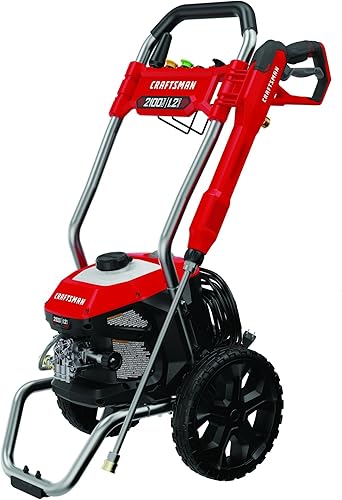
The CMEPW2100 gives the hose, cord, wand and nozzles onboard storage places. Its 25 ft hose and 35 ft cord offer reach around a typical home outlet area.
Pros
- Storage for hose, cord, wand and nozzles
- 25 ft kink-resistant hose
- CETA certified
Cons
- 32 lb unit
- 1.2 GPM flow
The Craftsman CMEPW2100 gives the hose, power cord, wand and nozzles dedicated onboard storage places. This can help keep the accessories together between jobs, especially if the washer lives in a garage or shed.
It has 2100 max PSI and 1.2 GPM, plus a 25 ft kink-resistant hose, 35 ft power cord, 10 in wheels and a soap tank built into the gun. Craftsman identifies it as CETA certified.
Choose it if accessory storage and cord reach are high on your list. Skip it if you'll need to carry the washer often, since it weighs 32 lb.
How do you choose the best electric pressure washer for your home?
Choose an electric pressure washer by matching output, nozzle choice, reach and storage to your surfaces and work area. A washer for car care may not be the one you want for large concrete areas or a long path around the house.
What pressure and flow should a best electric pressure washer have?
There isn't one ideal pressure and flow combination for every home. PSI measures water pressure, while GPM measures flow, which affects how quickly loosened dirt rinses away.
For a practical comparison, check rated PSI and GPM when the brand provides them. Maximum figures can reflect different conditions, so compare the numbers with their labels and context rather than assuming every maximum means the same thing.
The pressure washer GPM vs PSI guide explains how each number affects cleaning. Use the pressure washer size guide to match output to the surfaces and buildup you expect to handle.
Which nozzle should you use on each surface?
Start with a wider spray on paint, siding, vehicles and wood, then test a hidden area before working across the full surface. Keep the wand moving at a consistent distance so one spot doesn't receive all the pressure.
A turbo or 0° tip concentrates force into a smaller area. Keep it away from people, pets, windows, vehicle paint and soft materials, and follow the manual's distance guidance for each surface.
Use the soap tip or soap applicator when the machine supports detergent application. Apply a detergent approved for the surface, let it work as directed, then rinse with an appropriate spray pattern.
How much cord and hose reach do you need?
Measure from the outlet to where the washer can stand, then from the machine to the farthest point you need to clean. The cord and hose work together, so a longer cord won't make up for a short hose if the machine must remain near the outlet.
A 35 ft cord gives more room to position some frame models, while a 25 ft hose is common among the picks. Avoid assuming any extension cord is suitable; follow the washer manual and keep all plug connections away from water.
Can an electric pressure washer clean a driveway?
Yes, an electric pressure washer can clean many driveways when its output, nozzle and pace suit the surface. Use a wide spray, work in overlapping passes and avoid directing a narrow tip into cracks, loose joints or damaged concrete.
For large flat areas, a compatible pressure washer surface cleaner can make coverage more even. See our guide on how to pressure wash a driveway for a step-by-step approach to preparation and passes.
Is an electric washer enough for house siding and decks?
An electric washer can handle siding and deck cleanup when you use a suitable nozzle and keep the spray at a safe distance. Treat older paint, soft wood, gaps and trim with extra care, since concentrated pressure can mark or force water behind surfaces.
For siding, follow the method in how to pressure wash a house without damaging it. For wood, read how to pressure wash a deck before selecting a tip or starting near the grain.
How do you set up and care for an electric pressure washer?
Set up the washer on stable ground, connect the water supply and hose, and clear air from the system before powering it on. Use the model's manual for exact connection order, detergent guidance and electrical requirements.
Before plugging in, check that the hose and fittings are connected securely and that the water supply is turned on. Squeeze the trigger with the washer off to let water run through the hose and wand, which helps reduce trapped air.
Use an outdoor grounded outlet and any included GFCI protection as directed. Keep the plug and connections dry, don't handle them with wet hands, and avoid using an extension cord unless the manufacturer allows it and specifies the right type.
After use, turn off the machine and water supply, then release pressure by squeezing the trigger. Disconnect the hoses, drain remaining water, clean the nozzle openings with the supplied tool when applicable, and store the unit and accessories where they won't freeze.
For cold-weather storage, follow our pressure washer winterizing guide. If the washer doesn't start or stops producing a steady spray, check the manual and our guide to common pressure washer starting problems.
What mistakes should you avoid with an electric pressure washer?
The most common mistake is choosing by maximum PSI alone. A higher number doesn't tell you whether the unit has the rated flow, hose reach or nozzle range you need, and it doesn't make a narrow spray safe for every material.
Another mistake is starting too close to a surface. Begin at a greater distance with a wider tip, make a short pass in an inconspicuous spot, then move closer gradually only if the surface tolerates it.
Don't point the wand at people, pets, electrical equipment or fragile edges. Avoid using a turbo or 0° nozzle on delicate surfaces, and don't let the spray sit in one place.
Finally, don't let the cord or hose dictate an unsafe setup. Reposition the washer when needed, keep connections out of puddles, and never pull the machine by its hose or power cord.
Which electric pressure washer should you choose?
Choose the Westinghouse ePX3500 for compact storage and easy rolling, the WPX3000e for longer cord reach, or the Greenworks 3000 PSI Brushless if its stated flow and brushless motor suit your priorities. Choose the ePX3100v when you need a lighter washer to carry, or the Sun Joe SPX3000 when separate detergent tanks matter.
Skip a corded electric model if you regularly clean far from a suitable outlet or need the mobility and sustained work capacity of a gas washer. For a household shortlist, compare our best pressure washers for home use.
Our top 3 picks at a glance
-
1
-
2
-
3
Frequently asked questions
What is the best electric pressure washer for home use?
The Westinghouse ePX3500 is a strong fit for many homes because it combines a compact 19 lb body, four steering wheels, a 25 ft hose and five nozzle options. Its rated output is 2000 PSI and 1.2 GPM.
For more reach, compare frame models with a 35 ft power cord.
Is a higher PSI electric pressure washer always better?
No. PSI is only one part of cleaning, and a narrow nozzle can put too much force on paint, wood or other soft surfaces.
Match the nozzle and distance to the surface, start with a wider spray, and test a hidden area first.
Flow rate also affects how quickly you can rinse loosened dirt.
What is a good GPM for an electric pressure washer?
For household cleaning, compare both GPM and PSI rather than choosing by either figure alone. The products here range from 1.1 to 2.3 GPM in stated or rated figures, with some maximum flow claims tied to a nozzle or pressure condition.
Use the rated figures when available to compare typical output.
Can an electric pressure washer clean a driveway?
Yes, an electric pressure washer can clean a driveway when its output and nozzle suit the surface and soil. Work in overlapping passes with a wider spray, and avoid holding a narrow tip close to concrete joints or damaged areas.
A surface cleaner can help make broad, flat passes more even.
Do electric pressure washers need a special outlet?
These are corded electric models, and some include a GFCI power cord. Follow the manual's electrical requirements, use a grounded outlet, and keep plug connections away from standing water.
An extension cord can affect performance or safety, so use one only if the manufacturer permits it and specifies the right type.


